Most creators on Fanvue spend more time thinking about their subscription price than almost any other decision, and then lose more revenue from their inbox than from any pricing mistake. Subscription price matters. It is not the most important variable. Here is what the actual data from my own account suggests about where to set it and why most creators get this wrong in both directions.
What Is a Good Fanvue Subscription Price?
A good Fanvue subscription price for a new or growing account is between $7 and $15 per month. Below $7 the platform's payment processing fees eat a meaningful share and the low price signals low exclusivity, which reduces tip and PPV intent from subscribers who might otherwise spend more. Above $15 for a new account without established social proof, the conversion rate from profile visit to subscribe drops significantly because the price requires a level of trust a new visitor has not had time to develop. The $9.99 to $12.99 range is where most mid-size accounts find the best balance between accessible entry and perceived value. The subscription price is the door. What happens inside the account is where the real revenue is made.
Why Setting Your Fanvue Price Too High Backfires
A high subscription price on a new or unproven account filters out the exact subscribers who eventually become high-spend fans. The fan who converts at $14.99 with no social proof is not a better fan than the one who subscribed at $9.99 and spent $80 on PPV over two months. The high-priced account gets fewer subscribers, has less inbox activity, and loses the volume of fan relationships needed to identify who the high-value buyers actually are. You cannot upsell someone who did not subscribe. Creators who lower their subscription price from $15 to $9 and then invest in chat quality consistently report overall revenue increases because the subscriber base grows, and a larger active subscriber base produces more tips and PPV opens. The math favors a lower door price with strong interior conversion.
Should You Offer a Free Trial on Fanvue?
Free trials on Fanvue attract subscribers who are browsing rather than committed. The conversion from free trial to paying subscription is lower than most creators expect, typically 15 to 30 percent depending on the account and the trial length. The fans who convert from a trial tend to be lower-spend than fans who paid from the start because the act of paying creates a different psychological relationship with the account. Free trials make sense in specific situations: when you are building an initial subscriber count for social proof, when you are testing a new content style, or when you have a large external audience you can warm up before asking them to pay. As a permanent acquisition strategy, free trials train the wrong type of subscriber and suppress the signal you need to understand what your paying audience actually wants.
How Much of Fanvue Revenue Comes From Subscriptions vs PPV?
In my account, subscriptions represent a small minority of total revenue. The majority comes from PPV and tips generated through active DM conversations. The image below shows a snapshot of earnings where this split is visible: subscription income is consistent but modest, while PPV and tip income varies significantly based on how much inbox activity was happening that month.
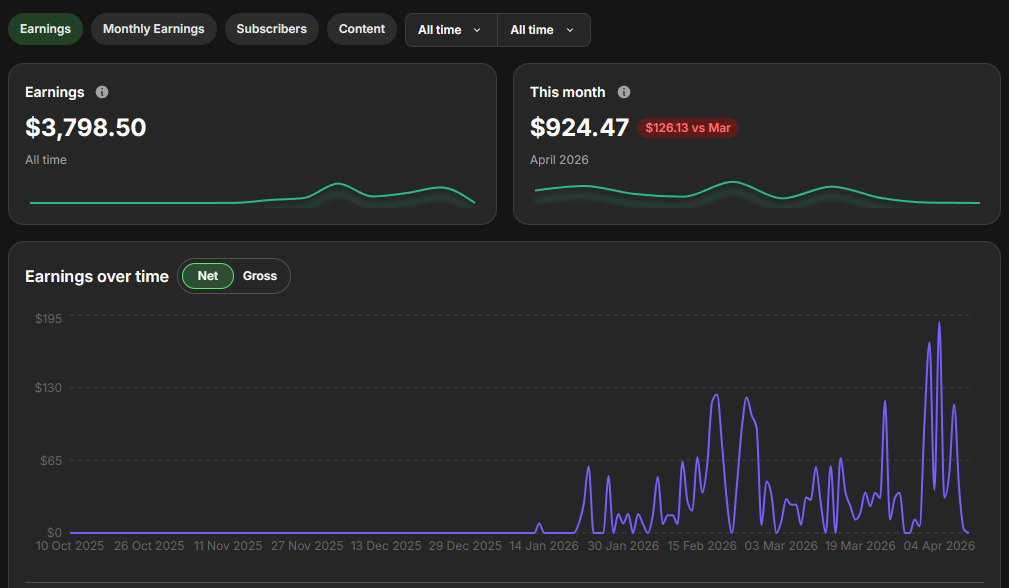
Real Fanvue earnings. Subscription base is consistent; PPV and tips are the growth lever.
When Should You Raise Your Fanvue Subscription Price?
Raise your Fanvue subscription price when your conversion rate from profile visit to subscribe is above 8 percent and your 30-day retention rate is above 60 percent. Both metrics together mean the account is converting well and keeping subscribers once they arrive. Raising price before either metric is solid reduces the conversion rate without improving revenue per subscriber, which is the worst outcome: fewer subscribers and the same spend per fan. Creators who raise price after proving retention almost always see total revenue stay flat or increase because the existing subscriber base stays, new subscribers at the higher price point generate more per head, and the social proof of an existing subscriber count supports the higher price for new visitors.
Is Fanvue Subscription Revenue Reliable?
Fanvue subscription revenue is predictable but not passive. Subscribers who are not receiving regular inbox engagement and new content cancel at a higher rate than those who are. The recurring nature of subscription income depends on recurring engagement from the creator's side. This is the reason most creators who treat their Fanvue account as a content upload platform rather than a conversation platform see high churn: subscribers pay for a month, receive content they cannot interact with, and let it lapse. The accounts with the most stable subscription bases are the most conversational ones. The subscription model works best when it is the entry to a relationship, not a Netflix-style content feed.
Set a price that gets people in the door. Then make the door worth walking through.