The welcome message is the first DM a new Fanvue subscriber receives. Most creators either skip it entirely or send something so generic it could belong to any account on any platform. That is a significant missed opportunity, because the subscriber who just paid is at peak curiosity and the welcome message is your only chance to set the tone for everything that follows.
Here is what I have learned about what the welcome message actually does to retention and revenue over the first 30 days.
What Should a Fanvue Welcome Message Say?
A Fanvue welcome message should do three things: acknowledge the subscriber personally, set an expectation for what the relationship looks like inside the account, and open a door for conversation rather than close it with a statement. The mistake most creators make is treating the welcome message as an announcement. "Welcome! Here you will find exclusive content updated weekly." That is a FAQ, not a conversation opener. The version that converts to further engagement introduces something specific: a question, a preview of something coming, or a reference to how the creator talks to people here versus on their public pages. The goal is a reply. A subscriber who replies to the welcome message is 3 to 4 times more likely to still be subscribed 60 days later than one who reads it and moves on.
How Long Should a Fanvue Welcome Message Be?
Two to four sentences. Long enough to feel personal, short enough that a new subscriber reads all of it without scrolling. Welcome messages that run to a paragraph or more tend to feel like onboarding documentation rather than a message from a person. The optimal structure is: one sentence acknowledging they are here, one sentence that reveals something specific about what they will find or what you are like inside the account, and one sentence that invites a reply. "Hey, glad you're here. I post differently here than anywhere else, more personal, less filtered. What brought you to Fanvue?" That is it. Three sentences. It takes three seconds to read and it starts a conversation.
Does a Welcome Message Actually Affect Revenue?
Yes, measurably. The welcome message is the first point at which a subscriber forms an impression of whether this account is interactive or passive. Passive accounts, ones where subscribers feel they are consuming content rather than talking to someone, generate significantly lower tip and PPV revenue per subscriber than interactive ones. A subscriber who receives a welcome message and replies is already in a different mental category from one who did not. They are not consuming, they are talking. Fans in conversation mode spend more. The image below is from one active subscriber thread, showing what a single engaged fan can spend over time once the initial conversation sets the right tone.
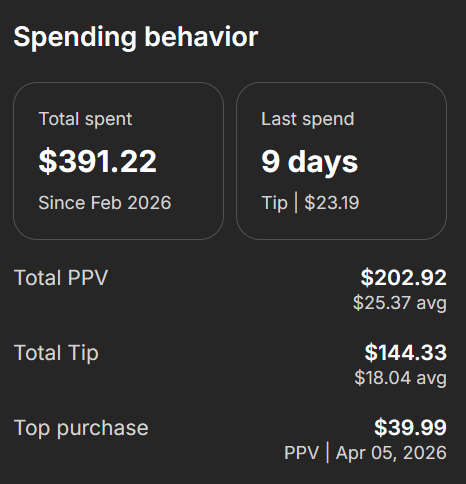
One subscriber session after a strong welcome and ongoing conversation.
Should You Automate the Fanvue Welcome Message?
Automating the welcome message is one of the highest-leverage automation decisions a creator can make, because the timing matters more than the personalization at this stage. A subscriber who pays and receives silence for four hours is already cooling off. A welcome message that fires within a minute of subscription, sounds like you, and opens with something specific performs better than a handwritten message sent six hours later. The automation risk is the same as always: if the message sounds templated, it signals the account is passive. The fix is writing the welcome message in your own voice and testing it manually with a few subscribers before setting it to send automatically. Once it reads like you, automation handles the timing problem without sacrificing the personal feel.
What If a Subscriber Does Not Reply to the Welcome Message?
Send a second message 48 hours later. Not a follow-up that says "did you get my last message" but something entirely new: a preview, a question about something you just posted, anything that creates a new entry point. Subscribers who do not reply to the welcome message have not made a decision about the account yet. They subscribed, looked around, and got busy. The second message gives them a second reason to engage before they have formed a habit of ignoring the inbox. Creators who run a structured two-message welcome sequence see meaningfully higher 30-day retention than those who send one message and wait. The sequence does not need to be long. It needs to give a quiet subscriber two chances to start talking before that window closes.
The welcome message is two sentences that determines whether a subscriber becomes a fan or becomes a number. Most accounts treat it like a formality. That is the gap.